
Emerging Mobility & Travel Behavior

We study how changes in technology, work, and everyday life affect travel. Our research examines differences across generations, the relationship between online activities and physical travel, and how people use and respond to new mobility services.

Research Themes

Generational Mobility & Automobility

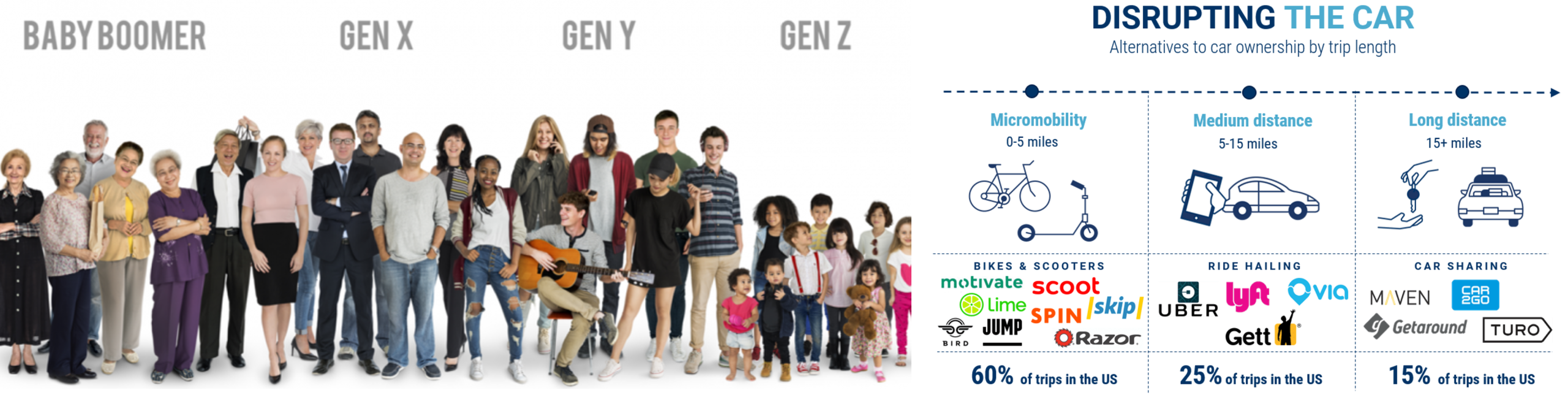
This work examines differences in driver licensing and car use between Generation Z and Millennials. We consider attitudes toward driving alongside income, household circumstances, and the built environment to understand how preferences and practical constraints shape these differences.
  • Generation Z
  • Millennials
  • Driver Licensing
  • Automobility

Illustration of generational cohorts alongside micromobility, ride-hailing, and car-sharing alternatives.
Illustrative overview of generational cohorts and alternatives to private car ownership.
View full-size image

Digital Life, Remote Work & Activity-Travel Change

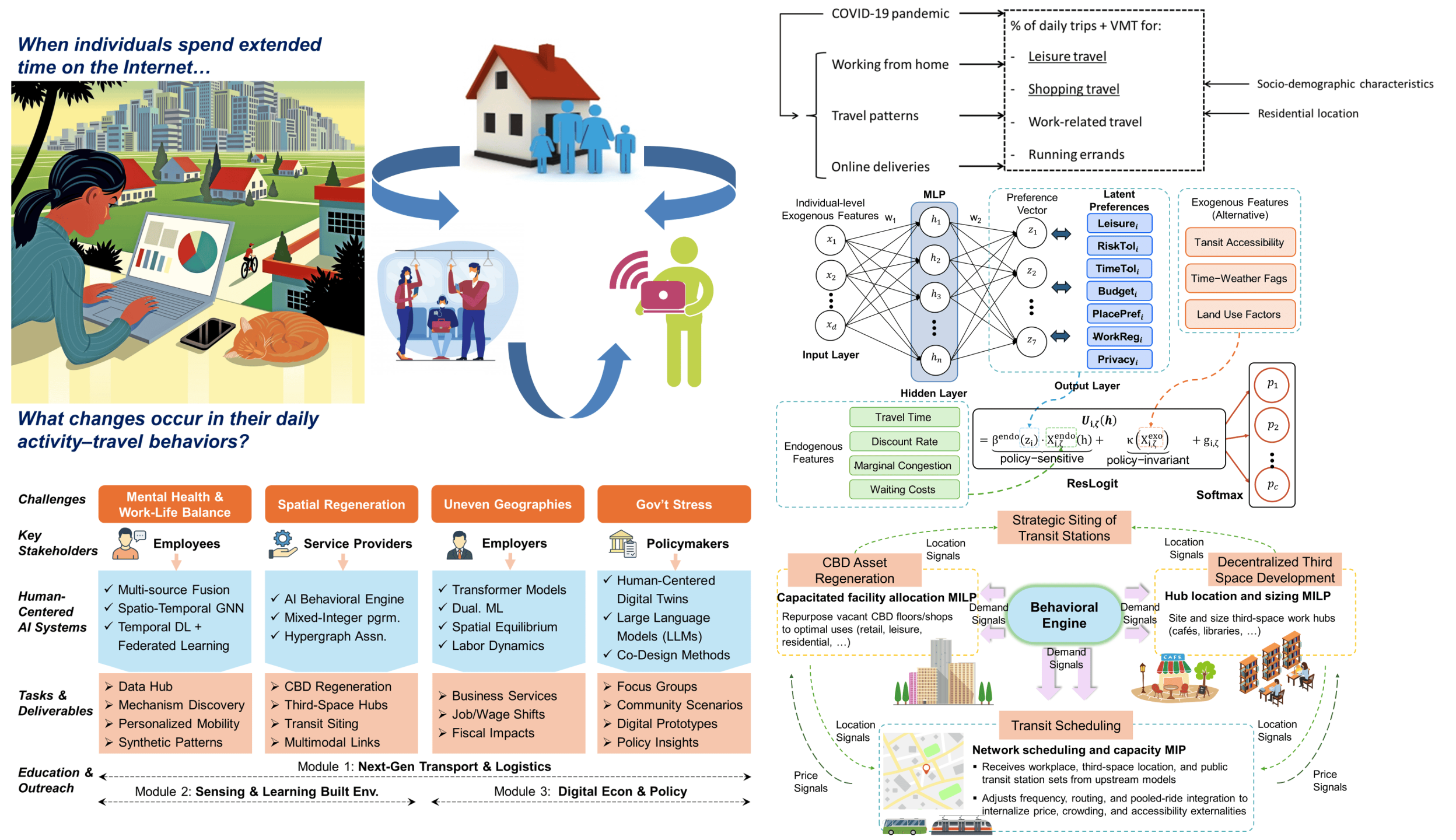
Working, shopping, and spending leisure time online can change when and why people travel. We examine whether these activities replace trips, generate additional travel, or shift journeys to different times and places, with implications for commuting and other everyday activities.

  • Remote Work
  • Virtual Mobility
  • Online Shopping
  • Activity Patterns

Conceptual diagram linking digital activities and remote work with travel behavior, behavioral modeling, and infrastructure planning.
Conceptual overview of digital activities, travel behavior, and infrastructure planning.
View full-size image

Shared, Automated & Emerging Mobility

Our research examines the use of shared micromobility and preferences for automated vehicles. We study how adoption varies across communities and which trips shared services replace, including walking, public transit, and driving.

  • Shared Mobility
  • E-Scooters
  • Automated Vehicles
  • Technology Adoption

Examples of app-based travel, ride sharing, bike sharing, accessible transit, shared cars, e-scooters, and automated vehicle concepts.
Illustrative examples of shared and emerging mobility services.
View full-size image

Selected Publications

Generational Mobility

2025

Wang, K., De Vos, J., Smart, M., & Wang, S.

Explaining Youth Driver Licensing Determinants Using XGBoost and SHAP.

Transport Policy, 168, 87–100.

2024

Wang, K.

Are Generation Z Less Car-Centric Than Millennials? A Nationwide Analysis Through the Lens of Youth Licensing.

Cities, 149, 104951.

Digital Activity & Travel Change

2025

Wang, K., & De Vos, J.

Trends in leisure and shopping travel: From pre- to post-COVID-19 pandemic.

Travel Behaviour and Society, 39, 100956.

Emerging Mobility Adoption

2024

Zhong, H., Wang, K., Li, W., Burris, M. W., & Sinha, K. C.

An urban–rural divide? Preferences for autonomous vehicles in small and mid-sized metropolitan areas.

Applied Geography, 169, 103324.

2023

Wang, K., Qian, X., Fitch, D. T., Lee, Y., Malik, J., & Circella, G.

What travel modes do shared e-scooters displace? A review of recent research findings.

Transport Reviews, 43(1), 5–31.

View all publications

Looking Ahead

Our next step is to examine which changes in travel persist over time. Using longitudinal data and simulation, we aim to assess how different patterns of remote work and technology adoption affect future travel demand and infrastructure needs.

  1. Digitalization
  2. Behavioral Adaptation
  3. Activity & Travel Change
  4. Infrastructure Response

Research in the News